7-Minute Intention Checklist (Printable + Digital, AI)
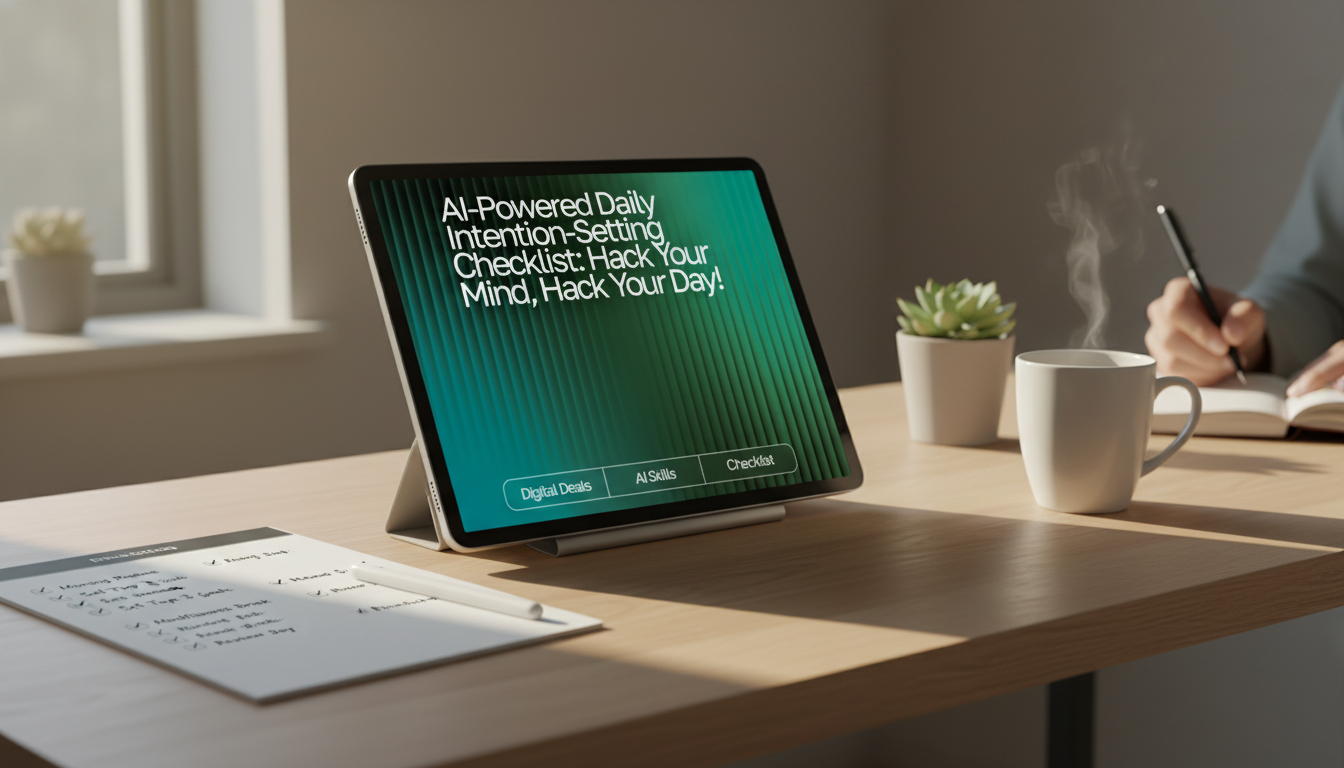
AI-Powered Daily Intention-Setting Checklist: A Simple Printable + Digital Routine for Mindful Productivity
A clear intention can turn a busy day into a meaningful one—without adding more to-do’s. This AI-powered daily intention-setting checklist is designed as a quick, repeatable routine that helps choose a focus, align tasks to values, and close the day with reflection. Use it on paper, on a tablet, or inside a notes app to build consistency in minutes.
What “daily intention” means (and why it feels different than a to-do list)
A daily intention is a guiding principle for how to show up—not just a list of what to do. It’s the difference between “finish emails” and “communicate clearly and calmly,” which influences how you write, how quickly you respond, and what you choose to ignore.
- Intentions act like a filter. When meetings pop up or plans shift, an intention helps decide what matters without rethinking everything from scratch.
- They reduce decision fatigue. Instead of repeatedly asking “What should I do next?”, you ask “What fits my intention?” and eliminate noise faster.
- One intention can support multiple goals. A single theme (like steadiness) can improve focus, boundaries, emotional regulation, and follow-through.
- Mindful productivity blends outcomes with awareness. Progress counts, but so does the way the day feels—especially under stress. (For a deeper look at how stress affects the body, see the American Psychological Association’s overview: https://www.apa.org/topics/stress/body.)
If you want a simple definition of intention, the APA Dictionary of Psychology is a helpful reference: https://dictionary.apa.org/intention.
What’s included in the AI-powered checklist (printable + digital use)
The checklist is built to be quick, practical, and repeatable—so it can support real schedules (not ideal ones). It includes:
- Morning intention prompt: pick one theme (clarity, patience, courage, steadiness, presence).
- Priority funnel: identify 1–3 outcomes that matter most today and why they matter.
- Energy check: a fast scan of sleep, mood, and bandwidth so expectations stay realistic.
- Focus plan: choose a “first small step” (2–10 minutes) to reduce friction and start smoothly.
- Distraction guardrails: decide what to ignore, postpone, or say “no” to for the next 6–8 hours.
- Evening reflection: capture wins, lessons, and a gentle reset for tomorrow.
For a ready-to-use version, see the AI-Powered Daily Intention-Setting Checklist (Printable & Digital Routine Guide).
Printable vs Digital: how to use the checklist
| Format | Best for | How to use | Tip |
|---|---|---|---|
| Printable (paper) | Reducing screen time, building a calm morning ritual | Print one page per day or reuse with a sheet protector | Keep it next to coffee/tea so it becomes automatic |
| Tablet + stylus | Flexible planning, quick edits | Import as a PDF into a note app and write directly on it | Duplicate yesterday’s page to track patterns |
| Phone/desktop notes | On-the-go intention setting | Copy the prompts into a daily note template | Set a reminder to complete the evening reflection |
A 7-minute daily routine: morning setup to evening close
This routine is designed to work even when the day is already in motion. Keep it short enough that consistency wins.
- Minute 1: breathe and name the intention in one sentence (example: “Move through the day with calm focus”).
- Minutes 2–3: choose today’s top outcomes; make them observable (define what “done” looks like).
- Minute 4: pick one small starting action (2–10 minutes) to create traction.
- Minute 5: identify one likely distraction and pre-decide the response (silence notifications, block time, place the phone in another room).
- Minute 6: align tasks to the intention—remove or defer one item that doesn’t fit.
- Minute 7 (evening): record one win, one adjustment, and one gratitude or positive moment.
On days when “mindfulness” feels like one more demand, use the smallest version: intention + one outcome + one boundary. If you’d like additional context on mindfulness practices, the NIH overview is a solid starting point: https://www.nccih.nih.gov/health/meditation-and-mindfulness-effectiveness-and-safety.
Intentions that match real life: examples for common days
Intentions work best when they’re realistic and behavior-based. Here are examples that match the kinds of days that actually show up.
- High-pressure day: “Be decisive and kind.” Pair with one must-do outcome and one boundary (example: no extra meetings after 3 p.m.).
- Creative work day: “Stay curious.” Pair with a protected deep-work block and fewer check-ins.
- Family-heavy day: “Be present.” Pair with a shorter priority list and a pace that doesn’t punish you for interruptions.
- Low-energy day: “Do the next right thing.” Pair with micro-steps and extra recovery time.
- Conflict or difficult conversation: “Listen before responding.” Pair with a quick grounding routine before the meeting.
How AI support can strengthen the habit (without making it complicated)
Common mistakes and quick fixes
Who this routine helps most
Helpful add-ons for a smoother morning routine
- AI-Powered Daily Intention-Setting Checklist | Printable & Digital Routine Guide for Mindful Productivity
- The Cozy Corner That Changes Mornings: Ultimate Breakfast Nook with Banquette Seating Guide
FAQ
How is an intention different from a goal?
An intention is how you want to show up today (your mindset and behavior), while a goal is an outcome you want to achieve. Intentions guide moment-to-moment choices and can support goals without adding extra pressure.
How long should daily intention-setting take?
Plan for 3–7 minutes in the morning and 1–2 minutes at night. On busy days, a minimal version (one sentence intention + one priority) is enough to keep the habit intact.
Can this be used if the schedule changes constantly?
Yes—use one stable intention as an anchor, choose micro-priorities you can complete in short blocks, and do a 60-second reset at midday to realign when plans shift.











Leave a comment